

Talking about sleep duration usually leads to general recommendations: eight hours, seven for some, a bit less for others. However, through our experience at Personal Rest, we know that the ideal amount of rest is not just a number. It responds to body structure, activity levels, biological rhythms, and the quality of the support we sleep on.
Rest is not a universal formula. It is a deeply individual process.
Sleep Works in Cycles, Not Hours
Throughout the night, we pass through several phases that repeat in sequences known as cycles. Each one lasts approximately 90 to 110 minutes and includes:
- Light sleep, which begins the transition into deep rest.
- Deep Sleep, where the majority of physical regeneration occurs.
- REM sleep, associated with memory consolidation, learning, and emotional balance.
Health depends on completing enough cycles, not just accumulating minutes in bed. A mattress or pillow that triggers "micro-awakenings" interrupts these cycles, even if the person believes they are sleeping the "correct" number of hours.
How Many Hours Do We Really Need?
Scientific literature agrees on a general range, but practical experience—especially with athletes, those with high cognitive demands, or users with demanding lifestyles—reveals important nuances:
- Healthy Adults: Between 7 and 9 hours, depending on their biological rhythm.
- Athletes and Intense Training: 8 to 10 hours may be necessary to optimize muscle recovery.
- Individuals with High Mental Workloads: May require more stable and deeper cycles to maintain daily clarity and performance.
Beyond the number, the essential factor is continuity. That is, sleeping without interruptions that fragment the cycles.
Proper Support: A Determining Factor in Actual Sleep Duration
It is not enough to simply stay in bed; the body must find a stable and coherent environment to move through each phase without tension.
At Personal Rest, we develop systems that allow sleep to flow naturally:
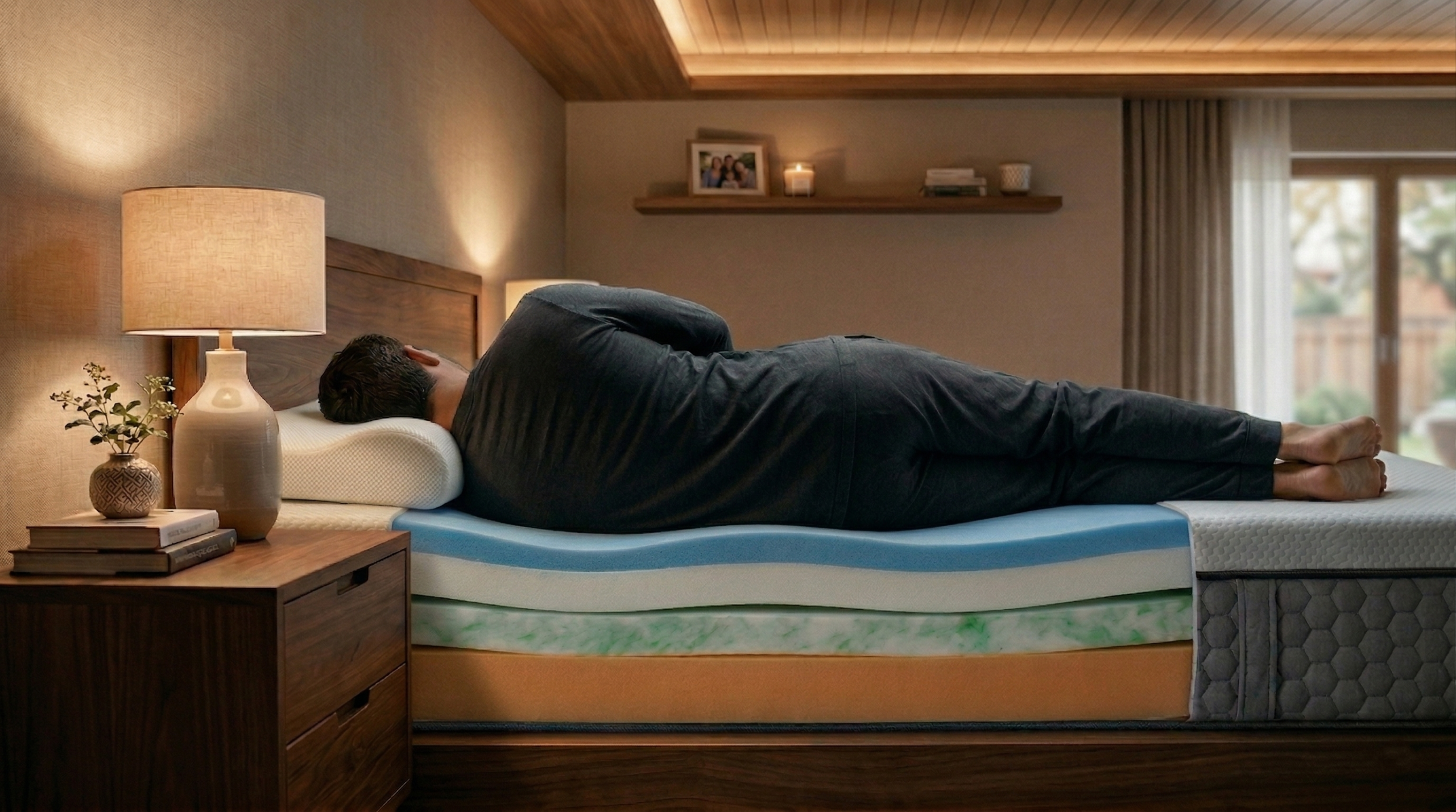
- Adjustable Panels in the Modular PRO: Eliminating pressure points and maintaining neutral spinal alignment.
- Anatomical Design of the 1 OFF 1: Responding directly to the user’s biomechanics, reducing micro-awakenings.
- PersonalRest Pillow: Capable of maintaining the cervical-thoracic relationship without variations during the night.
When the body is correctly supported, the depth of sleep increases, and the need for additional hours often decreases.
Sleeping Enough Isn't Sleeping More: It’s Sleeping Better
The relationship between hours slept and well-being is not always linear. Two people can sleep eight hours, but only one might complete quality cycles. The difference usually lies in the support: when the body rests on a surface that does not respect its morphology, it spends energy compensating for imbalances—energy that should be destined for repair.
A mattress or pillow that aligns with the physical structure optimizes sleep time rather than simply prolonging it.
A Personal Approach to Rest
At Personal Rest, we start from a simple premise: every body has its own rhythm, anatomy, and way of sleeping. That is why we create systems that are adjustable, measurable, and designed to evolve with the individual.
Understanding how many hours we need to sleep is important. But understanding how the body must be supported during those hours is even more decisive.
Sleep time is finite. Quality, however, can be elevated with precision. It is at this intersection—between science, craftsmanship, and personalization—where truly regenerative sleep happens.